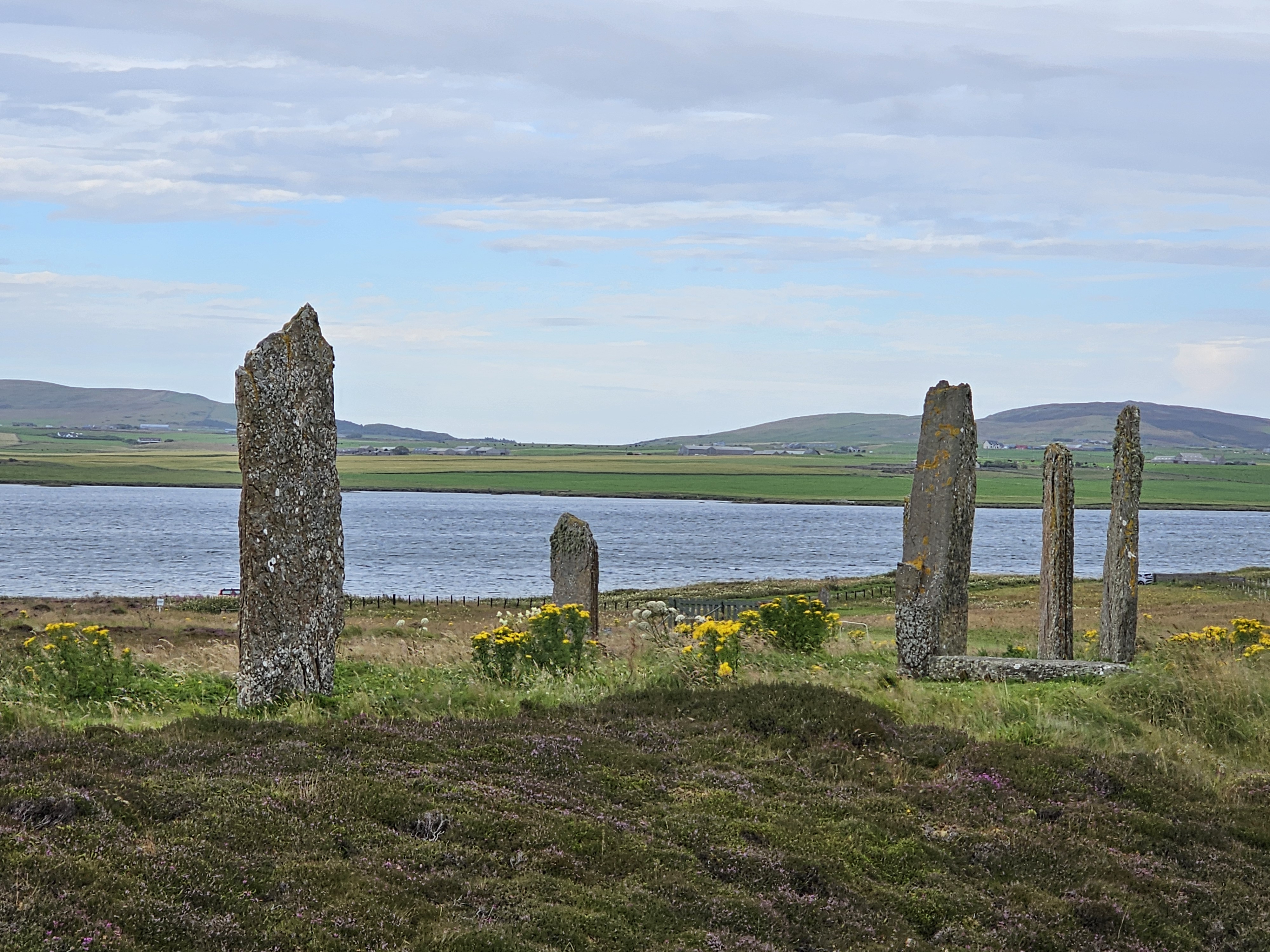
Remember my post the other day on the Ring of Brodgar? In August an article came out saying that analysis showed that the grey-green sandstone of the altar stone at Stonehenge came from northern Scotland, possibly Orkney? Well, now new information has surfaced. They still think it came from Scotland, but have determined that it did not come from Orkney.
After seeing The Stones of Stenness, Maes Howe, and Skara Brae, I didn’t think it could get better. But it did. We got to go to an active archaeological dig!
Ness of Brodgar covers 6.2 acres. Excavation on this Neolithic site began in 2004 and ended this summer. We were lucky enough to be there on the last open house before they closed the site. Isn’t that cool? Some of the structures were started around 3300 BC, but the there is evidence of activity way before that.
We made a brief stop at the Kirbuster farm museum. The Fire Hoose is from 1595. Note the stone roof.
Robert Stewart, half-brother of Mary Queen of Scots, became Earl of Orkney in the late 1500s. This is what’s left of his palace in Birsay.
But the real highlight of the day was the Ring of Brodgar
They don’t know much about Brogar, but they think it was built between 2600 and 2400 BC. It is older and bigger than Stonehenge. It may have been used to observe the moon.
36 of the original 60 stones have survived. The tallest is 4.7 meters tall.
The circle is 104 meters in diameter and is encircled by a 135-meter henge.
BTW, while I was there, an article came out about the alter stone at Stonehenge. Seems it wasn’t quarried from Wales as originally thought. It came from North Western Scotland Orkney area.
Wrapped up our last night on Orkney Island with dinner from the sea. Wondering what those things around the scallops are? They are the reproductive organs. Did you know that scallops are hermaphrodites?
Since my first art history class in collage, I’ve been fascinated by paleolithic and neolithic art. Stone circles like Stonehenge were important to the first novel I wrote. (still unpublished) So when I say August 4th was the day that I was most looking forward to, I mean it. (Don’t believe me? Look at the header on my homepage.) This trip was a dream come true. We were transported in spirit back thousands of years and treated to wonder after neolithic wonder.
The first stop was at the Standing Stones of Stenness. This is the oldest henge in the British Isles and is only five miles northeast of Stromness on the mainland of Orkney. It originally held 12 stones, but only four upright stones are still standing. They are 6 meters high. The people who built this did not have fancy machinery and trucks. All these stones were hand quarried and hauled there. Local outcry stopped the farmer from pulling them down in 1814! He was tired of ploughing around them. Unfortunately, the Odin Stone was already destroyed.
According to local tradition, a couple who held hands through the hole in the Odin stone would be bound in marriage.
Maes Howe doesn’t look like much from the outside, but there is magic within. Built around 3000 BC, Maes Howe is a burial chamber that is accessed by a nine-meter-long tunnel. When it was opened in 1861, the excavators discovered it had been previously visited over 800 years earlier. How did they know this? The interior is covered in a collection 30 runic graffiti and animal carvings.
According to stories, in 1153, a group of Vikings took refuge during a snowstorm.
Some of the inscriptions read: “Ofram the son of Sigurd carved these runes” “These runes were carved by the man most skilled in runes in the western ocean” “Ottarfila carved these runes”“Tholfir Kolbeinsson carved these runes high up” “Orkis’ son says in the runes he carves”
There were a few other, more ‘colorful’ inscriptions, but you get the idea. Basically, bored guys haven’t changed in thousands of years.
These are a few pictures of the landscape around Maes Howe.